In Harstad, Norway, the world’s first Newton Room continues to inspire. Hans Jørgen Riddervold now welcomes teachers who, as pupils themselves, once explored STEM in the classroom. The Newton Teacher has also created the module The Coolest Fish, now part of the International Module Library.
Name: Hans Jørgen Riddervold
Age: 48
My Newton Room
The Newton Room in Harstad is the world’s very first Newton Room, which makes them incredibly proud. Established in 2007, they now find that some of their visiting teachers recall and share memories from their own childhood visits.
They run the modules We Explore Energy!, Search and Rescue, Robots and Circumference, Mission Possible: The King’s Treasure, The Inventor, their own module The Coolest Fish, as well as some modules that are still available in Norwegian only. They also run a couple of more experimental or unfinished modules at various stages of development.
Over the last few years, they have aimed for a broader palette of modules, with their own The Coolest Fish as one of the latest additions to the International Module Library.
You have been a part of Newton since: Hans Jørgen became a Newton Teacher in 2020
Professional Background:
He started with a Master’s degree in mathematics combined with some programming, and later studied pedagogy, physics, chemistry, and biology. Hans Jørgen has worked at several types of schools, teaching students from a very young age to adults.
Life Outside of Work:
Hans Jørgen lives with his family a bit outside Harstad, in an area with abundant nature and scenic views. He enjoys hiking in the local woods, as well as playing and building classical guitars. Guitar building is a perfect blend of physics, mathematical simulations, practical woodworking, and creativity, but it is also time-consuming and progresses slowly. The woods are where he finds his daily silence—and new ideas.
What sparked your interest in STEM (Science, Technology, Engineering, Math) in the first place?
“As teenagers, we were allowed to go outside school during the longest break, so three or four of us visited the local library more or less every day, searching for books and magazines about STEM. I’ve also had some engineers scattered within the family, as well as some teachers who recognised my interest. So I think I’ve been lucky when it comes to STEM.”
What do you love most about working in a Newton Room?
“I love the students’ ‘wow’ experiences, and being able to highlight their own creativity and reasoning. I also appreciate the possibilities of making new modules, for example, The Coolest Fish. At the moment, I’ve got some new programming module ideas up my sleeve. I hope to release them sometime during the next couple of years.”
What’s your favourite topic or module to teach, and why?
“Well, I think my favourite module is The Inventor. However, the new module, The Coolest Fish, is perhaps the one that gets the most immediate praise from visitors, regardless of whether they are kids or adults. That’s, of course, always a good experience.”
What do you hope students and teachers take away from their visit to your Newton Room?
“I hope the students will remember how they mastered whatever stuff we worked on. I hope they’ll feel that they made some clever choices. For instance, quite often the visiting teacher tells me that we’ll have to keep an eye on some specific students because of potential trouble, and almost equally often those students end up with some of the very best work! Such experiences are important for these students. We all judge each other and put students (and everyone) too easily into ‘boxes’. I want to break those boxes.”
Can you share a fun or inspiring story that happened in your Newton Room?
“I find the most inspiring stories to be those short and daily stories. For instance, yesterday the visiting teacher told me that one of her students had thanked her heartily in a quite formal manner at the end of the day. The student felt deeply thankful for the opportunity to visit the Newton Room, because he felt he was challenged, and at the same time, he felt he had succeeded.”
How can we best inspire children and young people to pursue STEM education and careers?
“Well, I’m not sure that I’ve got the best answers here. To some extent, I guess the answers may vary between different countries. However, it’s always important to have some STEM-related role models, I think. Students will always need to have their own personal reasons for STEM education.”
If you could meet one famous scientist, past or present, who would it be and why?
“What a difficult question! Perhaps Edvard and May-Britt Moser, the Nobel Prize winners in Medicine some years ago. I’m sure I’d give them all kinds of weird and noob questions, but I would surely learn a lot.”
What are three things on your bucket list?
“As a Newton Teacher I would love to complete a couple of new modules about mathematics or programming. Some are less finished than others... On a private basis, I would love to harvest my own honey from the local flowers of the midnight sun. But as you can imagine, it’s hard for the bee colonies in the Arctic, with the long winter and a short summer. Time will tell!”
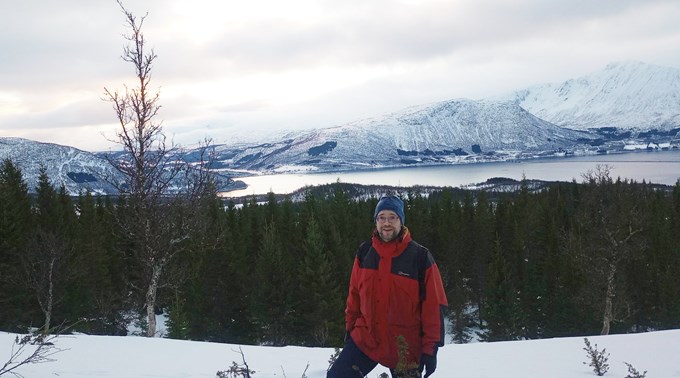
Hans Jørgen finds his daily silence in the woods at his homeplace in Harstad.
