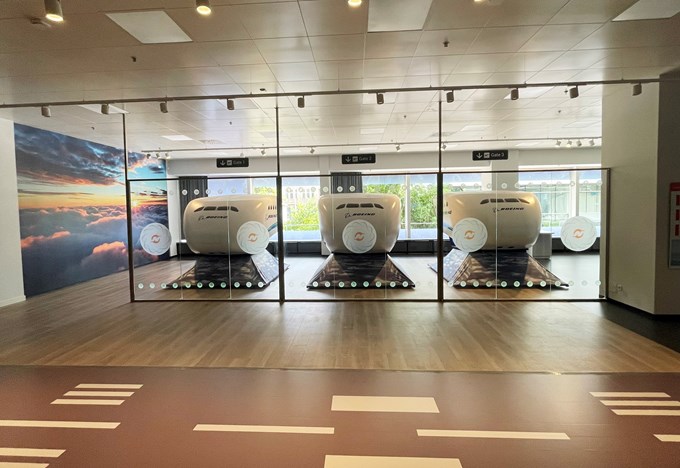
From learning therapy to Newton Flight Academy Brandenburg, Martin Richter has always been driven by a desire to make STEM accessible to all. Now, he has a new goal on his bucket list: creating his very own Newton Module for the International Module Library.
Name: Martin Richter
Age: 38
Newton Room: Newton Flight Academy Brandenburg
Location: Cottbus, Germany
Has been a part of Newton since: June 2024
Professional Background
“I studied industrial engineering and earned a master’s degree. Afterwards, I became a learning therapist specialising in dyslexia and dyscalculia. When my full-time position ended, I became a teacher of math, economics, vocational studies, and physical education. Ultimately, I was able to put all my skills to use as the director of the NFA Brandenburg.”
Life Outside of Work
“ I absolutely love playing volleyball, I coach a volleyball team, I spend a lot of time in the garden or at my cabin by a local lake, and I really enjoy skiing in the winter. In my daily life, I cherish every minute I get to spend with my goddaughter.”
What sparked your interest in STEM in the first place?
“I’ve always been curious about nature and the world around me and wanted to understand how things work. From a young age, I kept asking questions, building things with Lego, and working on small projects with my father, repairing and creating things together. Later on, I also got into programming, which opened up a whole new way of thinking and problem-solving. Even though I wasn’t always the most diligent student in school, I genuinely enjoyed science and languages, and that curiosity has stayed with me ever since.”
What do you love most about working in a Newton Room?
“What I love most is the opportunity to inspire young people through interactive and hands-on learning. Seeing students become curious, engaged, and more confident as they work on real-world challenges is incredibly rewarding. Another aspect I really appreciate is that I don’t have to focus as much on preparing the technical or subject-specific content for each session. Instead, I can put more energy into the pedagogical side, how to guide students, how to communicate ideas effectively, and how to create a supportive and engaging learning environment. That focus on teaching and interaction is what makes the experience so special to me”
What’s your favourite topic or module to teach, and why?
“One of my favourite modules to teach is “Up in the Air with Numbers” because it allows me to step back from the traditional role of a teacher and instead act more as a learning facilitator. I spend very little time lecturing and can focus much more on supporting students individually and responding to the needs of each group. I really enjoy that shift, as it creates a more student-centered and engaging learning experience.
I also love our holiday programs. Working with mixed-age groups creates a unique and dynamic atmosphere every time. The interactions are always different, and it’s exciting to see how students and (grand-)parents learn from each other. What makes it even more special is that the experience often continues beyond the Newton Room and has a lasting impact at home.”
What do you hope students and teachers take away from their visit to your Newton Room?
“I hope they leave with a sense of curiosity, confidence, and inspiration. Ideally, students realise that STEM is not only about theory but also about creativity, teamwork, and real-world applications. For teachers, I hope they gain new ideas for interactive and engaging ways to approach STEM education.”
Can you share a fun or inspiring story that’s happened in your Newton Room?
“One particularly inspiring experience we’ve had involves students who initially came to the Newton Flight Academy with very low motivation. We regularly work with lower-performing secondary school classes and even groups of students who have struggled to engage with school altogether.
In several cases, students arrived completely disengaged and hesitant to even start the first tasks—often because they were afraid of failing. But through well-structured, accessible challenges and a bit of guidance from a supportive Newton Teacher, something shifts. They begin to participate, try things out, and gradually gain confidence.
I especially remember one student who started the day withdrawn and uninterested, but over time became more involved and even proud of what he achieved. By the end of the session, he left with a smile and a noticeably stronger sense of self-confidence. What made this story even more meaningful is that he later returned to regular school after his experience with us.
Moments like these show how powerful the right learning environment can be.”
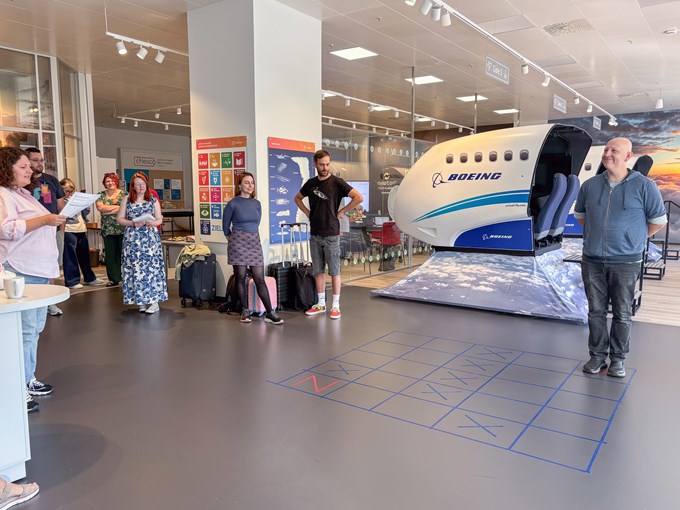
In September 2025, Martin and the rest of the Cottbus team welcomed the Newton Network to the annual Newton Partner Summit at Newton Flight Academy Brandenburg.
How can we best inspire children and young people to pursue STEM education and careers?
“To truly inspire young people, we need to reconnect STEM with curiosity and real-life experience. Many students lose interest because subjects like math, physics, or chemistry are often taught in a very abstract way, without a clear connection to their everyday lives.
We need to give them opportunities to experiment, explore, and actively make sense of the world around them. When students are encouraged to ask questions, test ideas, and see the results for themselves, STEM becomes something tangible rather than something intimidating.
It’s also important to create a learning environment where making mistakes is part of the process, not something to be afraid of. When students feel supported and capable, they are much more willing to engage. Ultimately, it’s about giving them both the tools and the confidence to understand the world, and showing them that STEM is not just theory, but something relevant, accessible, and meaningful in their own lives.”
If you could meet one famous scientist, past or present, who would it be and why?
“Although I find Nikola Tesla and Alexander Graham Bell incredibly fascinating, I think I would choose to meet the Wright brothers.
What inspires me most about them is their persistence. Despite countless setbacks and failures, they kept going and continuously improved their ideas. They were even willing to put themselves at risk during their experiments, which shows an extraordinary level of dedication to their dream. That kind of perseverance and belief in one’s vision is something I find truly motivating.
It’s a reminder that progress often comes through trial and error, and that real innovation requires not just knowledge, but also courage and resilience.”
What are three things on your bucket list?
“One thing high on my list is visiting CERN. I’ve already had two opportunities to go but couldn’t take them, which I still regret, so it’s definitely something I want to make happen.
Another goal of mine is to develop my own Newton Module and have it included in the International Module Library. The idea that students and educators around the world could use something I created to understand better science is incredibly motivating and meaningful to me.
And on a more personal level, I’d love to explore more of the world. I’ve already seen quite a bit of Europe, but I’m especially interested in discovering Asia and South America and experiencing new cultures and perspectives.”
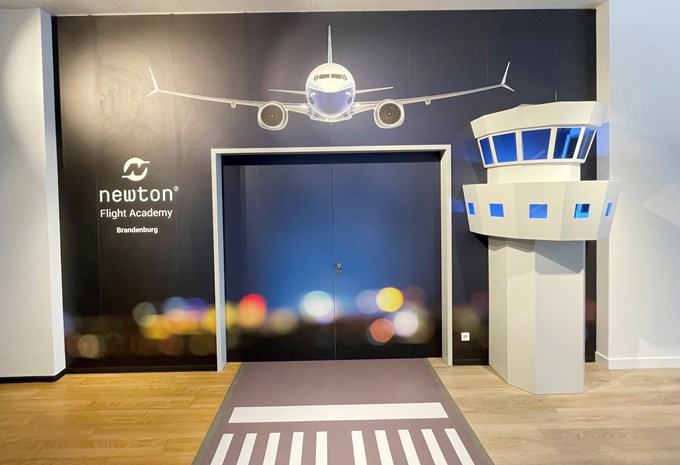
Newton Flight Academy Brandenburg
In July 2024, Germany’s first Newton Flight Academy opened in Cottbus, Brandenburg, as a collaboration between CHESCO, FIRST Scandinavia, and Boeing.
The Newton Room is staffed by two Newton Teachers and seven Newton Flight Simulator Instructors. The facility features three full-motion flight simulators, a science laboratory, and a modern classroom, offering a comprehensive and immersive STEM learning environment.
Three Newton Modules are currently delivered in the Newton Room: “Up in the Air with Numbers”, “Robots and Circumference” and “Life of the Bumblebee”.